- October 2, 2026
- AI, Algorithm, Books, Critical Thinking, Digital Humanities, Freedom, Human Sciences, Interviews, Philosophy, Sciences, Technology
Dr. Arantxa Serantes of Humanista Digital is interviewing me on the occasion of my new book Buscando a Ítaca.
«We find ourselves facing one of the greatest paradoxes of contemporary civilization: we have never had so much access to the recorded memory of humanity, and, at the same time, we run the risk of being the most forgetful culture in history»
Hence the title of the interview, although it could be perfectly different. In the conversation, Arantxa Serantes took me through the ideas of Buscando a Ítaca (Searching for Ithaca) to consider the place of the human being in the era of artificial intelligence, in digital humanism. Using the compass, the ship, and Ulysses’s voyage as metaphors, I argue that technology should expand thought, not replace it, and I defend personal sovereignty against cognitive delegation. Technological immediacy is the new siren song: it promises effortless knowledge and leaves us adrift, dispersed, and fragmented. To resist it, I propose three Homeric strategies: tie yourself to the mast of critical thinking and attention, learn to discard and say no to excess stimuli, and take the helm yourself instead of delegating the direction to the algorithm. In short, artificial intelligence must serve human beings and not replace their ability to think.
Turning to Skinner, I believe that Big Tech uses, even without intending to, intermittent reinforcement- algorithmic conditioning to capture the will, and I propose, as a desirable sign of the civilization of the future, the replacement of social and political control by the self-control of citizens in the pursuit of freedom, as well as the imminent need to reconcile distant reading with the intimate gaze. I maintain that the code is “frozen philosophy”, which is why I demand the presence of humanists in technological design and a real democratization of knowledge. I advocate a new renaissance that integrates the digital with the sciences and arts, and I conclude with a warning to new generations not to confuse the ship’s sophistication with the meaning of the journey.
- In your book, you use the journey to Ithaca and the figure of Odysseus as metaphors for the intellectual path. From a humanistic perspective, where the “path” is often mediated by algorithms, data flows, and hyperlinks, how can we avoid losing control of our own intellectual route and succumbing to the “siren song” of technological immediacy?
The siren song is one of the clearest epistemological warnings from ancient times. In the return to Ithaca, the sirens’ seduction lies in the promise of absolute knowledge without effort. They sang to Odysseus that they knew everything that had occurred on earth and that anyone who listened would leave wiser and full of joy.
Today, technological immediacy, the incessant flow of data, and the infinite jumping from hyperlink to hyperlink represent the digital version of that same song. It promises omniscience at the click of a button, instant access to the answer without having traversed the geography of the questions. Succumbing to that stimulus turns us into drifting navigators, devoured by acceleration and dispersion, and in numerous instances, into the very defragmentation of the unity of the human being. A process that gives rise to self-destruction, violence, intolerance, racism, and all the “isms” that separate people, including narcissism. Digital humanism must recover, in my view, three fundamental strategies from the Homeric journey: it must tie itself to the mast of critical thinking and the discipline of attention; activate with wax the selective capacity for discarding and rectification, as the only way to move forward is learning to say “no” to the overabundance of stimuli; and guide the ship’s helm instead of delegating the course to the algorithm—thus, the hyperlink and the search engine are extraordinary tools if used as navigation instruments, but they are disastrous if we cede to them the sovereignty of our own curiosity and initiative.
The journey to Ithaca is worthwhile not because of the speed with which one reaches the island, but because of the transformations, the learnings, and the inner battles the traveler experiences along the way. If technology saves us the effort of thinking, it is stripping us of the very essence of learning. The human sciences and computer science must ally not to artificially shorten the crossing, but to give the journey of human intelligence greater depth and horizon.
- In the preface, you allude to “the unexplored compass and the unfinished architecture.” If we translate this to the digital ecosystem, do you believe data analysis tools and artificial intelligence act today as that compass that expands humanistic questions, or do we risk automating critical thinking?
These images you mention, which I have used in the preface of my book, are not accidental; they contain a profound humanistic meaning because they imply deep-seated issues such as the vital impulse, the need to keep the flame of life alive, the curiosity to learn, the desire for the passions that move us to the adventure of knowledge not to end, and the fact that we still have much left to know. These are all deeply human matters, alien to any automatism. While all this is true, as I said in your previous question, we must preserve and protect the territory of thought; otherwise, we would face the context you mention: the automation of critical thinking and, consequently, the loss of personal sovereignty. The recipe to avoid it is complex and multifaceted; it involves putting the human being at the center of public dialogue and preventing the tool from replacing human capacity to think. We must redefine the purpose of AI, remembering that machines must serve humanity and not the other way around. The true competitive and evolutionary advantage lies not in processing data, but in cultivating that which makes us inherently human: emotions, relationships, identities, experiences. The era of AI is also the era of the search for humanism. It is about reaching a new renaissance that integrates digitalization with the sciences and the arts. Learning to think in the whole is not just cognition; it is also emotion, and without one, the gestalt of life breaks.
- As an expert in higher education and a university rector, you address the big questions in the book about how we educate ourselves. In an increasingly virtualized environment, what should be the non-negotiable core of the face-to-face and humanistic classroom in the face of automated learning platforms?
I have always argued that the university is not a simple container or a mere repository of academic content: it is, above all, a dialectical conversation, a shared inquiry into truth and its consequences. A living community of people who gather to think together, doubt together, and transform reality. If higher education is reduced to the mere transmission of information, the memorization of concepts, or the acquisition of purely mechanical skills, then automated learning platforms, algorithmic tutors, and artificial intelligences will do it better, faster, and with greater reach than we do. If the face-to-face university intends to compete only in efficient instruction, it is doomed to irrelevance.
I have maintained that animals are trained, while people are educated. Therefore, faced with the wave of virtualization sweeping the academic world, we must have the intellectual courage to define the non-negotiable core of the face-to-face, humanistic classroom without undermining all remote technologies. That core is not technological or procedural; it is deeply ontological and ethical. For this reason, we must combine the human factor and personal contact with new virtual, digital, and technological tools, always seeking efficiency. These issues are not exclusive but convergent: technology optimizes processes and improves performance; people build a collective project, a sense of belonging, and, at the same time, an impulse for permanent change. I firmly believe that knowledge does not exist until it is shared. Therefore, the leading institutions of the future must embrace this paradox; they must practice emotionally intelligent leadership: mediating tensions, supporting in crises, motivating in uncertainty, and using technologies within ethical parameters. Universities must address the challenge of being architects of this balance: we will use data without falling into algorithmic determinism, we will automate tasks without dehumanizing, we will innovate while respecting and attending to tradition and safeguarding what works, because genuine leadership is always a matter of people and acts reciprocally.
The university of the future must not turn its back on virtual technologies or automation; it must use them to free itself from bureaucratic and repetitive tasks. But that space gained from routine must be reinvested in humanizing the campus. Faced with the solitary hyperconnectivity of screens, the face-to-face classroom must stand as the sanctuary of contemplation, Socratic debate, and community commitment. Only then will higher education remain the lighthouse that ignites free thought and guides new generations on their way to Ithaca.
- One pillar of digital humanities is the archiving and democratization of knowledge. In your essays, you analyze contemporary culture and the meaning of life. How can we ensure that the massive digital storage of our historical and literary memory truly builds in-depth knowledge, not just data accumulation?
We face one of the greatest paradoxes of contemporary civilization: we have never had so much access to humanity’s recorded memory, and at the same time, we risk becoming the most forgetful culture in history. Confusing the digital archive with knowledge is a categorical error with enormous ethical consequences. The massive archive is a container; knowledge is a transformative experience. The server stores megabytes of text; the human mind interprets meaning through them. If we only democratize access to the storage but neglect the critical capacities to inhabit it, we will not have created a wiser society, but an immense data landfill.
Again, I return to the initial idea of this interview: never ceding the territory of thought to any algorithm and exercising and practicing reflection and critical capacity. We can have a digital repository of data, as we did with archives before, that facilitates access to information, and that is not bad—on the contrary. But what is irreplaceable is the symbiosis between teleological thought and reflective memory, indispensable in this new era of artificial intelligence (AI), which will allow us to distinguish between the plausible and the false, detect biases, and avoid cognitive sedentary behavior, and, more importantly, control the controllers, being able to self-control as the desideratum of human development.
In this context, education, educators, institutions, families, and individuals play a crucial role: we must work to educate for autonomy of thought. Only in this way can we avoid cognitive delegation, for assuming automatic answers without verifying sources and their consequences weakens analysis and recall. In education, we must also promote creative and thought diversity, as models generate only similar ideas and lead us toward one-track thinking. Therefore, we must reorient evaluation processes: valuing and exercising argumentation, the quality of doubt, and critical authorship. I am convinced that the world of the future will emphasize self-evaluation and self-responsibility, rather than the social control of those who should be controlled by society itself.
The true challenge of digital humanities is to ensure that the vastness of the archive does not crush us but serves as a platform to elevate our gaze and continue seeking truth, reflection, autonomy of thought, and personal sovereignty.
- In the book, you explore your experience with Skinner and the philosophy of freedom. Today, recommendation algorithms and social networks operate under strict behavioral conditioning principles. How can the new digital humanism help users regain autonomy from Big Tech’s predictive design?
Skinner demonstrated with rigor that the human being is extraordinarily vulnerable to positive reinforcement. Large technological corporations have inherited that premise and translated it into a digital mechanism: they do not need chains or direct censorship to subdue the will; they only need to design intermittent-reinforcement environments that turn human attention into a predictive loop. Let us not forget that Skinner called money a generalized reinforcer. Today we witness the technological realization of the Skinnerian experiment on a global scale. The problem lies in how we make other behaviors more powerful generalized reinforcers than money: compassion, sharing, trying, tolerating, loving, helping, caring…
Faced with this capture of the will, digital humanism’s response in the algorithmic era must focus on true autonomy and personal sovereignty. The first step is to reveal the architecture of control. Skinner was right: we are not free if we ignore the causes that determine us; therefore, digital humanism must form citizens capable of understanding the logic of behavioral design and developing a critical awareness of the biases and incentives that shape their interaction with the screen. Secondly, we must rethink education as the formation of the will, not mere competence: current technology is designed to erode deep attention span and contemplation, both of which underpin ethical judgment and critical thinking.
Humanistic education, therefore, must revalue silence, waiting, uncertainty, and effort, in the face of the instant gratification prescribed by algorithms. Predictive design seeks to reduce human existence to a series of expected responses to commercialize future behavior. The search for Ithaca—as a metaphor for personal fulfillment and lifelong learning—demands reclaiming true human freedom, which resides in the capacity to break the stochastic series, to choose the unproductive, and to maintain the ethical helm of one’s own destiny. Let us avoid being consumed subjects and bet on being creative and creating subjects. It is an error to believe that Skinner did not give the black box the importance it has. BF as such, as he titled his book, was beyond freedom and dignity. His great utopian bet for freedom through elevation is to make the human being capable of eliminating the controls of the controllers (social, economic, and political) and replacing them with personal self-control. The more self-control we exercise, the more freedom we acquire.
- Digital humanities allow us to analyze thousands of texts at once (distant reading). However, your book invites us to “stop, think, and look at reality with perspective.” Can we reconcile the massive scale of computation with the intimate, reflective look you propose in your essays?
The tension you point out strikes directly at the heart of the contemporary cultural crossroads: the temptation to confuse the scale of data processing with the depth of understanding. “Distant reading,” coined in the field of digital humanities, possesses an undeniable value: it gives us a computational telescope capable of observing galaxies of texts, revealing buried structures and conceptual drifts that would take a single individual several lifetimes to map. Denying this macro-analyzer’s heuristic power would be intellectual blindness. However, it risks succumbing to a new form of quantitative positivism: the belief that, by accumulating machine-processed patterns, we have exhausted the meaning of the human condition. The machine processes syntax and correlations; the human being interprets deep semantics, ethics, and transcendence.
Therefore, the reconciliation between the massive scale of computation and the intimate gaze I propose in Buscando a Ítaca is not only possible, but also urgent. We must work to make both points of view converge: the power of the algorithm must serve the humanist’s intuition; let us use computation to scan the forest, aware that true thinking requires entering the text and inspecting every detail, stopping to enjoy every leaf. Macrovision should invite Microvision, a map that shows exactly where we must stop to meditate. Stopping and looking with perspective means subjecting the mass of data to the sieve of methodical doubt, critical judgment, and aesthetic sensitivity. The machine gives us the statistical answer; the human being must formulate the ethical question.

- In recent interviews, you have mentioned that those who migrate are children of Odysseus. Currently, there is a massive migration toward purely digital identity environments (metaverses, virtual identities). What psychological or ethical gaps do you detect in this new form of “digital migration”?
When I affirm that we migrants are “children of Odysseus,” and I am one too, I mean that deeply human condition of embracing the elements, crossing uncertain seas, and carrying memory and nostalgia to build a horizon of dignity in a foreign land. Odysseus’ journey demands courage, risk, confrontation with otherness, and above all, the ontological desire to return to the homeland, to the Ithaca of personal truth.
The “digital migration” we witness today responds to a diametrically opposite nature: it is not a journey of discovery, but an exodus of evasion. One does not emigrate toward the virtual to inhabit the world, but to flee from it. I detect in this phenomenon cracks of enormous psychological and ethical gravity: there is the ontological void of incorporeity, as the hyper-constructed identity in the digital environment eradicates the finitude and friction of real life; what is obtained is not freedom, but an anesthetized existence. One migrates toward an environment where nothing hurts, but where nothing is fully real. On the other hand, I see a psychological void caused by “a la carte” identity: the traditional migrant suffers the tension of adapting their identity to a new culture without losing their essence. The “digital migrant,” in contrast, falls into the trap of solipsism or radical subjectivism by creating an identity tailored to their desires, a self purified of imperfections. This produces an unprecedented psychic fragility and brings us closer to narcissism as part of anti-learning. When the virtual image is perfect and daily life is complex, the subject ends up feeling like a stranger in their own skin, trapped in a perpetual dissociation, and we see the consequences in very young people without the capacity to endure frustration.
Finally, we witness an ethical void and the dissolution of the polis: ethics is born from the impossibility of “blocking” the neighbor; in physical space, the other imposes themselves on us with their difference and demands responsibility, tolerance, and commitment to community. Virtual environments and metaverses are designed as echo chambers in which users live only among those who reinforce their own biases, limiting diversity, tolerance, and fraternity. This migration destroys civic empathy: if the real world seems hostile or complex, we take refuge in simulation and abandon our ethical duty to transform society and leave future generations a better world than the one we inherited. Faced with this voluntary exile, new humanism must remember that the true journey is not creating a scarless avatar in a parallel universe but learning to inhabit our own humanity in the real world. The Ithaca we seek is not in the cloud; it is in the deep reconnection with our neighbor, with nature, with the reality of suffering and the fact that it is inevitable and surmountable, and with the unfinished truth of our own existence.
- In the opening pages of the book, you define each chapter as a needle oriented toward a beautiful and stormy sea: the “human experiment.” If the human experiment is being rewritten right now in programming code, what role do philosophers, methodologists, and historians play in designing tomorrow’s software?
Your question is certainly extraordinarily metatheoretically rich. When I use the metaphor of the needle oriented toward that beautiful and stormy sea that is the “human experiment” in the book, I do so with the conviction that navigating without the course of humanism and ethics can only lead us to shipwreck.
Today, that “human experiment” is being rewritten in programming languages, neural networks, and data architectures. However, we have made an epistemological error of historical proportions: assuming that the construction of the new digital world is a purely technical task that falls exclusively to software engineers, data analysts, and systems architects. Code is not neutral; it is frozen philosophy: each algorithm contains an implicit anthropology, a notion of the good, of value, of truth, and of ethics. If we allow the code of the future to be written without the contribution of the humanistic gaze, we will be programming an efficientist but deeply dehumanized future. Therefore, the role of philosophers, methodologists, and historians is not that of mere post-hoc ethical supervisors, but that of essential co-creators of technological architecture.
If code is the new grammar with which we write the destiny of the human being, universities and technological development centers must urgently promote radical interdisciplinarity. For we do not need engineers who ignore the humanities nor humanists who do not know computational logic. We need thinkers capable of holding the compass needle that points north while the code is traced, ensuring that the “human experiment” remains an adventure open to beauty, uncertainty, freedom, and the constant search for that Ithaca that gives meaning to our existence.
- Your book addresses politics and social equity in access to culture. How can digital humanities represent a real advance instead of becoming an elite discipline accessible only to universities with strong technological infrastructure?
This question addresses one of the most pressing debates in the sociology of knowledge and educational policy: academic gentrification. If we conceive of digital humanities only as the use of complex algorithms, supercomputing, and expensive proprietary software licenses to process data at scale, we will end up with an elite discipline. This would create an asymmetric academic aristocracy, in which a few universities or research centers would monopolize research capacity, and the rest of the world would be reduced to mere spectators or passive data providers. This would negate social equity and the humanistic spirit. For digital humanities to represent a real emancipatory advance, they must be articulated around an ethical, social, and political commitment.
Access to culture and knowledge cannot be a class privilege or a competitive advantage for corporations or advanced countries; it is a fundamental human right. If digital humanities do not serve to bridge inequality gaps, decentralize knowledge, and give voice to those forgotten by history, they will have failed in their essential mission. The true challenge of the new humanism is not to build inaccessible digital laboratories, but to put technology at the service of an open, shared, and universal culture, capable of weaving bridges of equity in every corner of the planet.
- If you had to summarize the final purpose of Buscando a Ítaca for new generations of researchers working at the intersection of computer science and the humanities, what would you say is the “true north” that we must not lose sight of in this change of era?
If I had to condense the fundamental message of Buscando a Ítaca for young researchers navigating that fascinating and complex frontier where silicon and letters, code and poetry cross, I would simply tell them this: never confuse the sophistication of the ship with the meaning of the journey. We live in a changing era in which fascination with technique threatens to eclipse the very purpose of existence. Computational tools—language models, big data analysis, artificial intelligence—are extraordinary sails that can propel our understanding at speeds previously unimaginable. But a ship without a rudder, or on the wrong course, reaches shipwreck even faster.
That “true north” is sustained by several non-negotiable certainties: the human being as the axis of development, as the supreme end, never as an algorithmic input; the primacy of the deep question over the quick answer; and the preservation of doubt, critical thinking, and illusion, or the capacity for wonder. A historical responsibility falls to the new generations: to be the true humanists of code. I hope they do not let technology absorb letters until it strips them of their soul, nor let letters isolate themselves in an ivory tower, ignoring the language of their time. Both new professionals and researchers must keep in mind that the world of the future will not be in the hands of specialists, but of all those who know how to integrate the knowledge of their specialty with that of those who are not part of it and who constitute the cognitive and affective essence of all knowledge. A new renaissance awaits us, integrating real and virtual knowledge.
We maintain the course toward Ithaca when we use technique not to replace thought, but to broaden it; not to automate existence, but to provide it with greater depth. That, and no other, is the ethical commitment that must guide every line of code and every page written in the university of tomorrow.
@ 2026 Miguel Ángel Escotet. All rights reserved. It may be reproduced, with credit to the source and the author. Interview given to me by Dr. Arantxa Serantes, faithfully reproduced from the Spanish version published by Revista Humanista Digital on September 29, 2026. You can also access the Spanish version of the blog here.
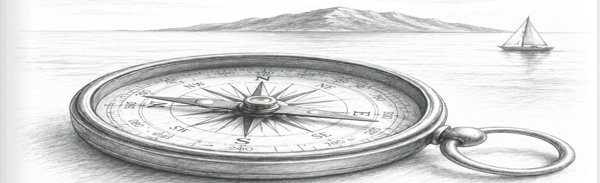
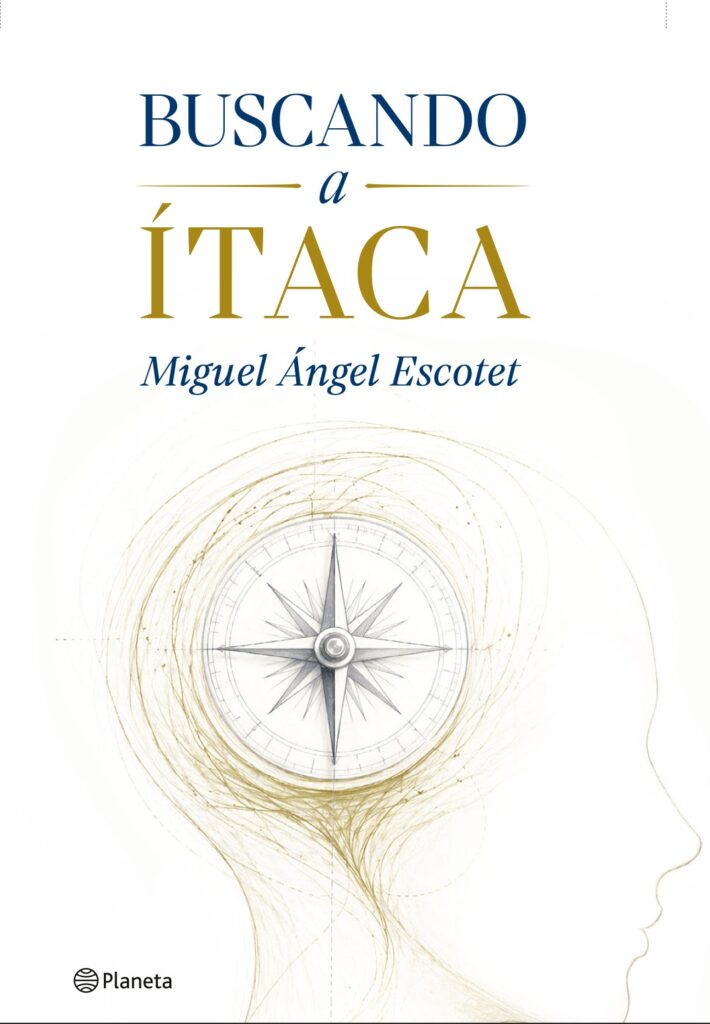
@Illustration credits: The cover corresponds to the first edition of the book, of 488 pages, in bound version, published by Planeta of Barcelona in June 2026. You can purchase it directly on Amazon. The photo of the interviewee is the same one that was published in the original Spanish version of the Humanista Digital interview. Finally, the top illustration identifying the article is an AI creation for this blog post that represents Ulysses’ Ithaca and the navigation compass, which the book refers to on many occasions.