- January 2, 2026
- AI, Artificial Intelligence, Education, Ética, Future, Higher Education, Neurotechnology, Sciences, Uncertainty
Generative AI will be one of the most significant technological developments for bringing education to a lifelong learning process. But humans with the hands and minds in artificial intelligence will have a major and transcendent task to accomplish, which is first to put the ethical and aesthetic obligations with humankind. A revolution of knowledge that is still missing. But what will be next? We need to be educated to solve unknown problems. However, our educational system emphasizes understanding problems that have already been solved. AI technology works to move ahead of what we know. It is part of AI reasoning. It is part of the machine learning DNA. We need to start thinking, as Pliny the Elder did, that «the only certainty is uncertainty.»
Although the first historical references to artificial intelligence date back to the 1930s with Alan Turing, the starting point of AI is 1950, when Turing published an article entitled «Computing Machinery and Intelligence» in the journal Mind. Already in 1943, the article «A Logical Calculus of Immanent Ideas in Nervous Activity» by Warren McCullough and Walter Pitts, was the first mathematical model for creating a neural network (Escotet, 1987). However, 2023 will likely be considered the year of exponential growth in artificial intelligence.
Technological advances have opened a world of opportunities for students and teachers lately. With new access to online and traditional learning platforms, the possibilities for furthering educational goals seem limitless. The trend in higher education seems to be toward making education more accessible and on-demand. Technology allows the online delivery of educational materials and rapid information sharing, allowing for quick and secure connections among learners. Students and faculty are no longer limited by physical distances and language barriers, allowing them to teach and learn virtually anywhere.
The rise of distance or online learning technologies has allowed for more customized coursework and blended learning models. This trend has enabled students to learn, work at their own pace, and customize their learning experiences to fit their goals. It opens up many options for the learning community, allowing for more flexible scheduling and access to courses of study and qualifications. But this change in scope and depth will require a significant difference in the teaching-learning process, faculty recycling, and students’ attitudes.
It is unavoidable that universities are changing rapidly, and the traditional model of higher education is under significant pressure due to an ever-evolving society, culture, and technology. Consequently, universities must become more digital and provide accessible remote learning platforms to remain competitive, stay up to date in each academic discipline, and remain attractive to students.
Moreover, universities are shifting away from the traditional classroom model toward project-based learning. This groundwork provides a much more enriching experience that encourages students to form their thoughts and create a valuable network of peers. Additionally, universities will increasingly use digital methods to support their teaching, both in the classroom and online, as technology plays an essential role in modern education. It is now possible to provide interactive experiences for students through digital lectures, virtual classrooms, team-teaching projects, virtual practices and applications, and various online resources. Other examples include the use of e-books, audiovisual material, virtual experiments, laboratories, science and humanities simulation projects, and online tutorials. But reading, one of the most important tools for human cognitive development, is declining dangerously due to its partial substitution by images and sound. AI can reinforce this behavior if the school system and society do not urgently work to compensate for the enormous reading deficit that already exists.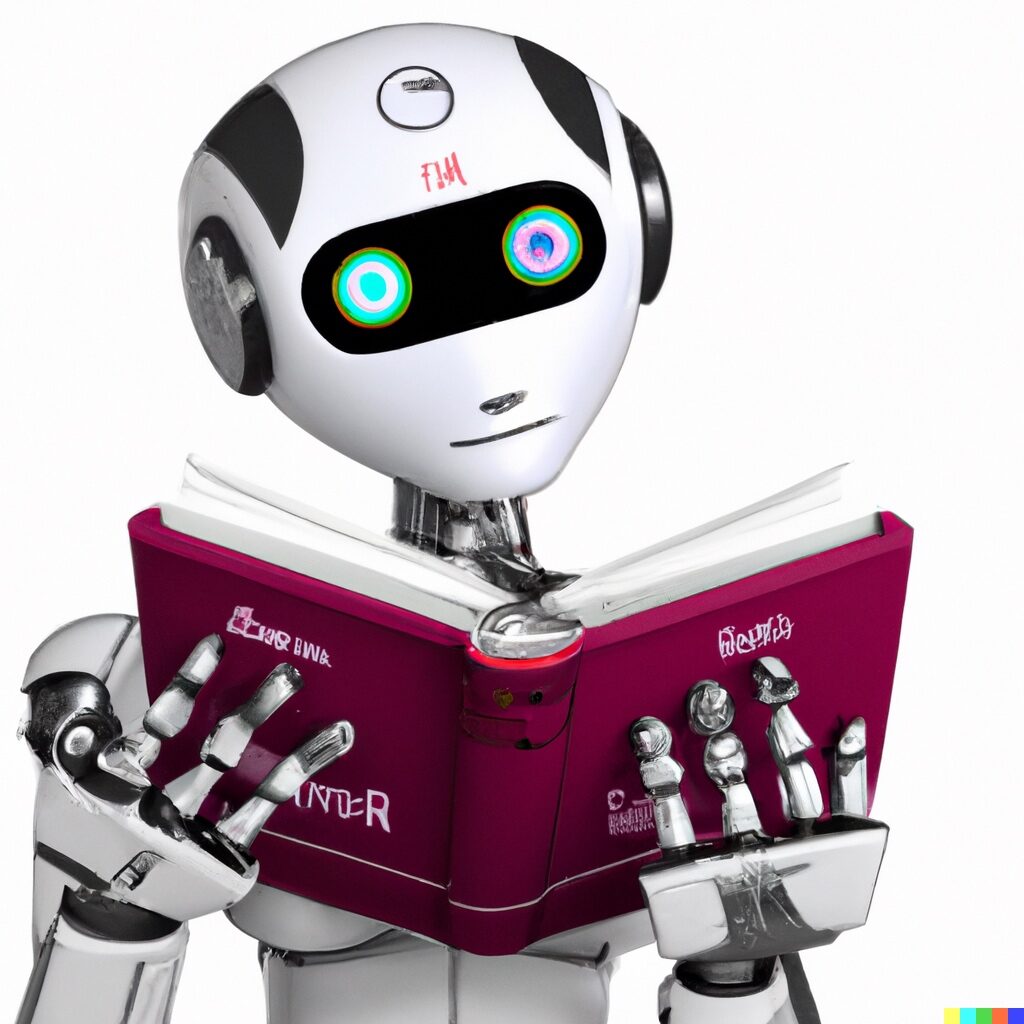
Are robots the readers of the future?
Technology is revolutionizing how students learn and access information, enabling greater access to learning opportunities, tremendous advancements in personalized education, and a platform for teachers to better reach students’ minds and hearts. Introducing new and innovative technologies, such as machine learning, into the educational sector can benefit many aspects, from improving the quality of teaching and learning to providing students with greater flexibility and access to resources outside the classroom. A significant change is developing an open education for all, according to their differences.
The introduction of augmented reality (AR) and virtual reality (VR) technology will revolutionize learning in higher education. For instance, devices such as virtual whiteboards and 3D simulations will enable teachers to bring lessons to life truly. Virtual field trips could also be possible in the near future, allowing students to explore virtual environments and gain a more in-depth understanding of their subject. In addition, personalized learning education becomes more accessible with artificial intelligence systems that track individual learning development to help them achieve life goals.
Artificial intelligence (AI) has seen significant advances in various fields, from medical diagnostics to navigation systems for autonomous vehicles. However, its capabilities are also most promising in «AI-driven learning.» Artificial intelligence can revolutionize how education is delivered and received by allowing for personalized instruction and interactive learning experiences. By providing real-time feedback, AI can make human-computer interaction more personalized and conducive to learning. AI technologies, such as Natural Language Processing, can provide lessons and create interactions with the students. AI can be used as an educational tool to personalize instruction for different students based on their needs. Artificial intelligence systems can provide tailored curricula and assessments for students based on their strengths and weaknesses. In other words, this innovative technology can give each student the support they need to succeed and excel rather than forcing them all into an identical mold. It can also help identify educational gaps and provide the appropriate learning solution.
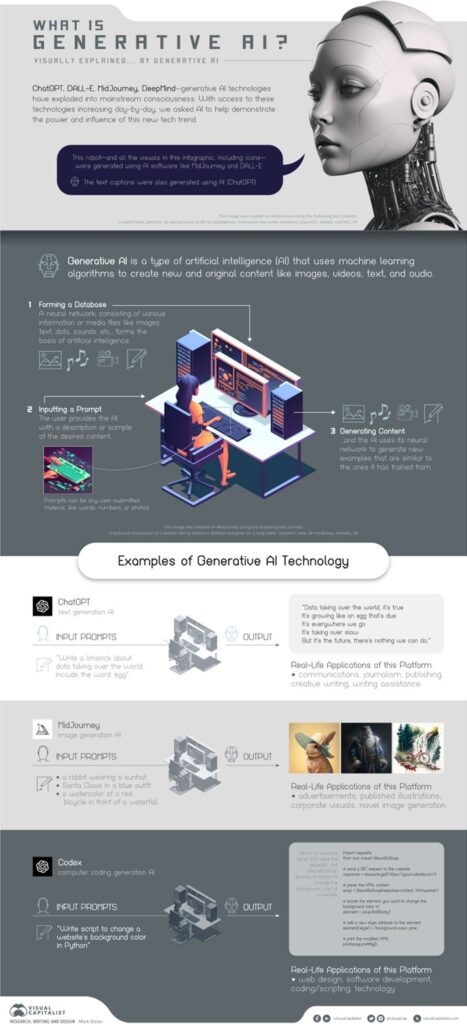
But generative artificial intelligence (GenAI) that can create a wide variety of data, such as images, videos, audio, text, and 3D models, can also make a deep change in how we teach, assist in scientific research, and organize and manage institutions of higher education. Rick Routley and Mark Belan from Visual Capitalist (2023) illustrate GenAI very precisely with the following infographic.
AI technology has transformed many industries and enterprises, and the education sector has been no exception. It can potentially revolutionize how schools, colleges, and universities operate with specific applications that dramatically improve the student experience and boost educational outcomes. AI-powered software, such as APE (Automated Performance Enhancement), can grade an essay in a fraction of the time it would take a regular teacher, freeing up more time for them to provide personalized feedback. AI can also review multiple-choice and short-answer tests much faster and more accurately than traditional methods and provide detailed analysis of test performance to the student and the teacher. Using AI-powered software, teachers can monitor each student’s academic progress and tailor the teaching to their individual learning needs, allowing them to focus on topics and other crucial educational teaching processes.
One example of this AI application is the use of intelligent tutoring systems (ITSs). They provide personalized, adaptive instruction and student feedback based on their assessments and progress. For instance, AI can provide students with exercises and activities tailored to their individual learning types and needs. This approach can improve student engagement and academic performance. In addition, ITSs can give students meaningful feedback on their progress and help them develop problem-solving skills. In other words, AI can not only support data-driven decision-making and quantitative analysis, but also provide paths for learning.
An intelligent guidance system could map students’ routes to their desired learning outcomes based on their current knowledge and understanding. This personalized guidance, incorporating psychological and social components, could help students develop based on their strengths and weaknesses. The evolution of these tools will significantly change education at all levels and for lifelong learning in the years to come. The job professional market will be aligned with lifelong learning. Several AI language models agree on identifying the current and emerging fields that may create new job opportunities, for instance, over the next five years. Here are some of the fields that may have potential growth:
- Artificial intelligence and machine learning.
- Cybersecurity and privacy.
- Renewable energy and sustainability.
- Healthcare and telemedicine.
- Data analysis and management.
- Robotics and automation.
- Blockchain technology and cryptocurrency.
- Content creation and digital marketing.
- E-commerce and online businesses.
- Remote work, e-learning, and virtual collaboration.
Of course, since the job market is constantly evolving, especially in these transition years, what we perceive as emerging fields today may not necessarily be the same tomorrow. Therefore, it is important to be adaptable, stay up to date, and enhance skills for future job opportunities. This requires flexible vocational and higher education study plans and careers, and learning flexibility is not always available in many countries and educational systems.
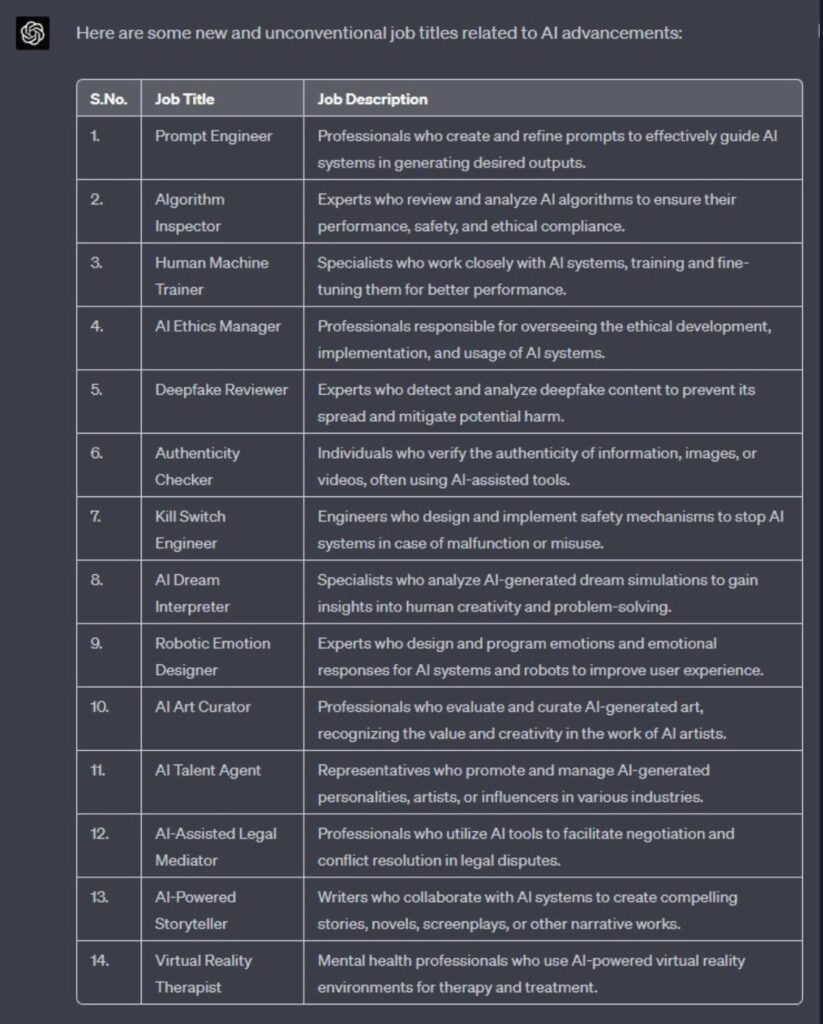
Furthermore, a significant change will affect the need for new jobs related to AI technology and the labor and professional markets worldwide. As a matter of fact, when asked what the new jobs related to artificial intelligence will be, ChatGPT provides the answer below in a conventional chart it generated. And this is a hypothetical answer in the middle of 2023. Considerable changes in the professional market will be produced month by month in the coming years, as we can see at the end of 2025.
In summary, the future of artificial intelligence in education looks promising, potentially improving the efficiency and effectiveness of teaching and learning. Some of the possible developments in this field include
- The transformation in the development of study programs based on AI. Professors can no longer be the prescribers of student learning competencies. The new programs with knowledge, applications, and dispositions will be covered in breadth and depth on what the learning person «should know» and not based on what the teaching person «knows.» New artificial intelligence techniques, data science, and predictive models will become necessary.
- AI will be a powerful tool for curriculum planning, design, and program implementation, aligning with society, students, and local and global needs.
- Greater Integration with Learning Management Systems: AI is expected to become more deeply integrated into LMS platforms, providing teachers and students with a unified, more efficient educational experience.
- Improved Personalized Learning: AI algorithms will become more advanced, enabling an even more customized, individualized learning experience.
- Improved Collaborative Learning: AI will facilitate more effective collaboration among students, teachers, and institutions, thereby improving educational and psychological outcomes.
- Virtual and Augmented Reality Applications: AI could significantly enhance VR and AR educational experiences, providing immersive, interactive learning opportunities.
- Natural Language Processing, or NLP. This technology converts text into data that can then be used to analyze, interpret, and generate insights. NLP is used to identify patterns and trends in large sets of textual data and to find correlations between elements in datasets.
- Increased Automation: AI is likely to automate more and more administrative tasks, freeing up teachers’ time to focus on student learning and development.
- Enhanced Collaborative Learning: AI will facilitate better collaboration between students, teachers, and institutions, improving educational and professional outcomes.
- Predictive Learning Analytics: AI algorithms can analyze student performance data and predict future learning outcomes, providing insights into student needs and helping professors or teachers target their teaching efforts better.
- Adaptive Learning: AI can adjust learning content and assessments to each student’s needs and abilities, providing a more personalized learning experience.
- Improved Assessment and Diagnostics: AI could play a significant role in
 developing more accurate and efficient assessment and diagnostic tools in psychology, helping to identify and treat student behavioral and mental health conditions.
 - Human-Computer Interaction Research: AI will significantly advance our understanding of human-computer interaction and how technology can support and enhance learning and psychological processes.
- Advanced Personalized Learning: AI algorithms will become even more sophisticated, allowing personalized learning experiences based on student data and performance.
- Health education, the potential for a health delivery system, the acceleration of the development of life-saving treatments, a patient-doctor health AI assistant, and the technological transformation of health systems.
- Mental Health and Wellness Support: AI-powered chatbots and virtual assistants can provide support, particularly for students in remote or isolated environments.
- Virtual Psychologists and Educational Counseling: AI-powered virtual psychologists and counselors may become more prevalent, offering support for learning techniques, learning to learn, and assistance with behavioral or mental health issues within the school or university community.
- Intangible learning, as a complement to real learning methods, will develop virtual scenarios, gaming, and simulation models to accelerate exponential learning, artificial intelligence (AI), and knowledge acquisition and transformation. It will change face-to-face and online education for anticipatory and predictive learning. The new methodological approach and standard will be intangible learning to reinforce research-based learning.
Of course, we also have multiple applications already used for two-way communication, and different media presentations are compelling for face-to-face or online learning. Here, the illustration visible on many social networks is a general chart with generative AI used in text, image, video, audio, 3D, and coding.
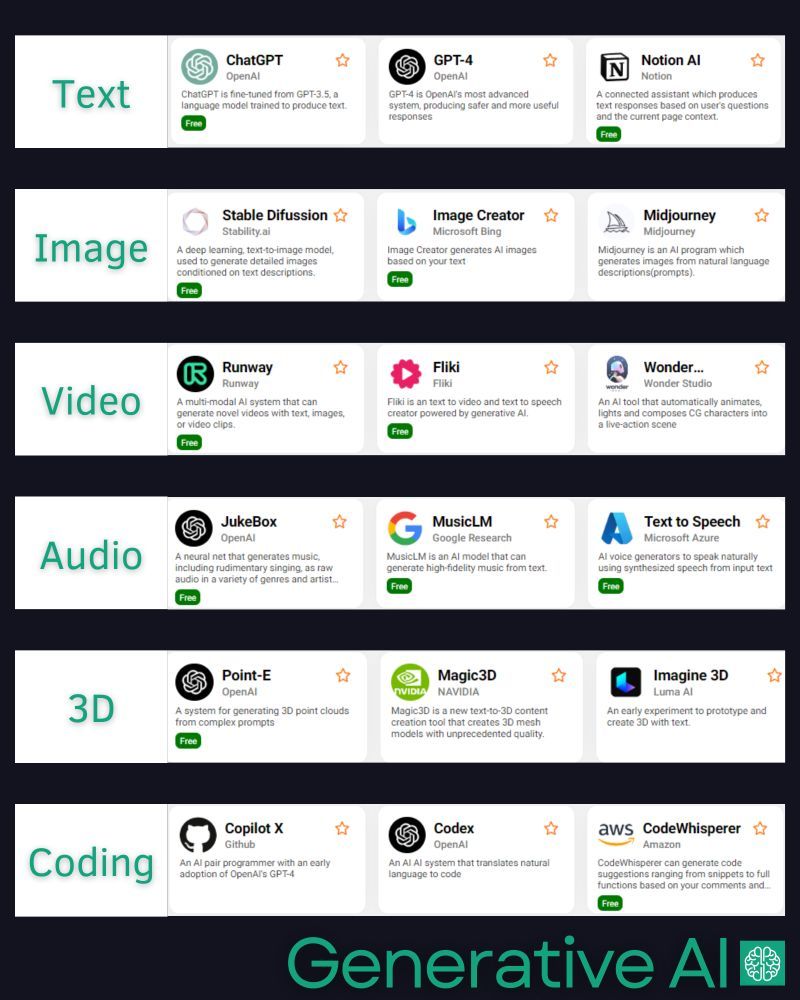
Open access illustration with some of the current generative AI in six dimensions.
Sentiment analysis, or opinion mining, is a powerful tool in teaching, research, and communication as a delivery system. It uses natural language processing and text mining to decipher the emotional context of written materials, making it a very sophisticated instrument for opinion and attitude studies and educational evaluation systems that measure emotions and qualitative data. «It can also be used to generate text that is specifically designed to have a certain sentiment.» For example, a generative AI system could be used to generate social media posts that are intentionally positive or negative to influence public opinion or shape the sentiment of a particular conversation. These can be useful for mitigating data imbalance in sentiment analysis of users’ opinions (as shown in the figure below) across many contexts, such as education and customer service (Dilmegani, 2023).
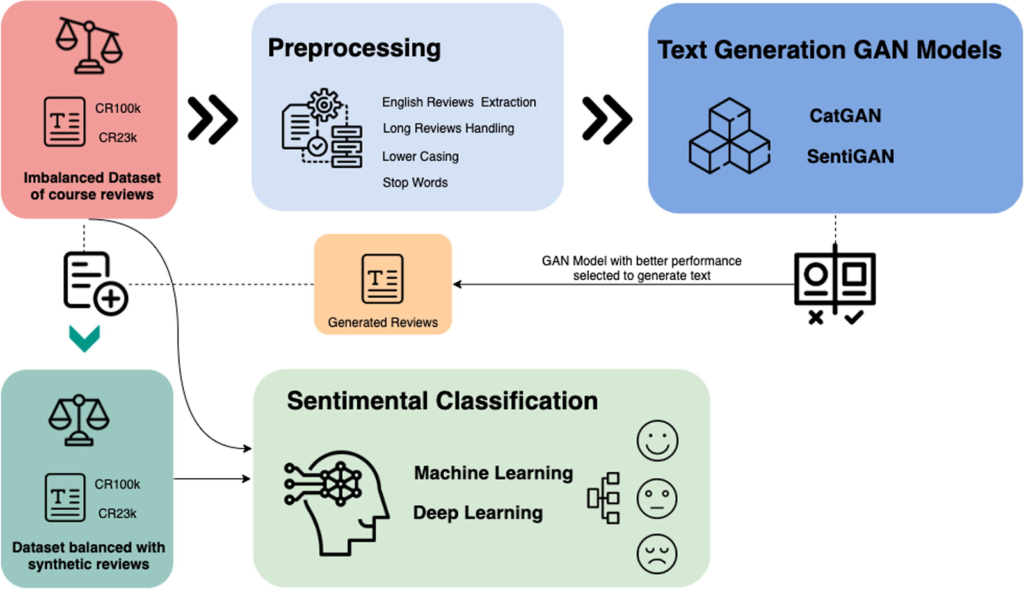
A high-level overview of a sentiment classification approach.
It has shown only a few, more or less sophisticated, applications that affect education at different levels and categories. It is only a basic sample. The future of AI in education, at all formal and non-formal levels, holds immense potential to improve how we learn, teach, and assess. AI technology has the potential to greatly enhance our understanding of learning and teaching, leading to improved educational outcomes, greater learning, and better life achievements, as well as enhanced support for mental and physical health for individuals and society at large. Generative AI will be one of the most significant technological developments for bringing education to a lifelong learning process. But humans with the hands and minds in artificial intelligence will have a significant and transcendent task to accomplish, which is first to put the ethical and aesthetic obligations with humankind. A revolution of knowledge that is still missing.
In terms of immediate and specific AI applications to higher education as well as general basic education, there are a few plain examples:
- Student support: AI-powered chatbots can assist students anytime, anywhere, and help address their concerns and questions.
- Tutoring personalization: AI-generated tutoring and feedback can provide a personalized, intelligent learning experience tailored to students’ interests, aptitudes, cognitive and affective competencies, and learning styles. It also allows professors to personalize their feedback to each student’s unique needs.
- Automated qualitative and quantitative grading: AI-assisted grading, self-assessment, and continuous evaluation of student assignments and tests. Grading systems can scale to accommodate large classes, distance learning, and individualized instruction, and provide immediate feedback to students, promoting quality performance.
- Education Data Analytics: AI can help analyze large volumes of quantitative/qualitative education data, including diagnostic, preventive testing, formative assessment, and criterion-referenced assessment data. In addition, AI is an important technology for test scoring, student and faculty evaluation, participation, attendance, and demographics, providing insights that help educators improve student performance and learning outcomes and enhance teaching.
- Educational planning and academic performance: AI is becoming a crucial tool in educational management, institutional planning and evaluation, curriculum development, course content design and relevance, and preventive/forecasting of external social and technological developments.
But what will be next? We need to be educated to solve unknown problems. However, our educational system emphasizes the understanding of problems already solved. AI technology works to move ahead of what we know. It is part of AI reasoning. It is part of the machine learning DNA. «For the first time, we’ve invented something that takes power away from us…and I do not know if humans can survive,» says Yuval Noah Harari (2023b), author of Sapiens. I want to think, on the optimistic side, that we will survive, and that a new, advanced, lifelong education for uncertainty will be the answer. We need to start thinking in line with Pliny the Elder, that «the only certainty is uncertainty.»
References
Dilmegani, Cem. (2023). Top 70+ Generative AI Applications / Use Cases in 2023. AI Multiple. Retrieve on April 27 at https://research.aimultiple.com/generative-ai-applications/.
Escotet, Miguel A. (2024). The optimistic future of artificial intelligence in higher education. Prospects (UNESCO). Towards 2030 and beyond: Challenges and opportunities for education transformation. 194, Vol. 54, Issues 3-4, December, pages 531-540.
Escotet, Miguel A. (2023). La universidad del futuro para una educación en red y a lo largo de la vida. En Santos Rego, M.A., Lorenzo Moledo, Mar y García Álvarez, Jesús (Eds.). La educación en red. Una perspectiva multidimensional. Barcelona: Editorial Octaedro, 161-192.
Escotet, Miguel A. (2020). Pandemics, leadership, and social ethics. Prospects (UNESCO), https://doi.org/10.1007/s11125-020-09472-3. Springer (Switzerland), June.
Escotet, Miguel A. (1991). The Transfer of Technology in Education. Budapest: Batthhyáni Association.
Escotet, Miguel A. (1987). Los modelos matemáticos del aprendizaje. Madrid: OEI Research Reports Series.
Harari, Yuval Noah.(2023a). Yuval Noah Harari argues that AI has hacked the operating system of human civilisation. The Economist (London), April 28.
Harari, Yuval Noah.(2023b). I don’t know if humans can survive AI. The Telegraph, April 23.
Holmes, W. and Porayska, K. (2023). The Ethics of Artificial Intelligence in Education. London: Routledge.
Langlois, Patrick. (2023). Artificial Intelligence. How to Manage It: Directly By ChatGTP. Kindle Edition.
Norvig, P. and Russell, S. (2021). Artificial Intelligence: A Modern Approach, 4Ed. London: Pearson Education.
Petzold, Charles. (2008). The Annotated Turing. New York: Wiley.
Roumate, Fatima. (2023). Artificial Intelligence In Education: Promises and Implications for Teaching and Learning. London: Springer.
Routley, Rick and Belan, Mark. (2023). Infographic: Generative AI Explained by AI. Visual Capitalist, Technology. February 1.
Sampedro, Javier. (2023). The bright side of artificial intelligence. El País (Madrid), May 4.
_____________________________
© 2025 Miguel Angel Escotet. This is a reviewed, condensed article from the one originally published on Prospects (2024). All rights reserved. Permission to reprint with appropriate citation.