
- November 4, 2025
- Education, Ethics, Higher Education, Human Rights Law Award, Social Justice, Social Philosophy
Kerry Kennedy inspires us not to remain silent, to use our voices and our platforms, no matter how big or small, to act and improve the lot of others. Thus, we will have fulfilled our conscience and what the human values of education mean in the force of the word compassion, and the law. But to achieve these goals, in addition to determination, persistence, and high ethical standards, I have always believed it was necessary to return to our origins. You must relearn to feel to understand.
It is a privilege to award Kerry Kennedy as a professor honoris causa of jurisprudence and to celebrate the life and work of a woman whose existence has been a beacon of hope and a call for action. For over four decades, Kerry has upheld the legacy of her father, Robert F. Kennedy, celebrating his birth centennial on November 20, as well as that of her mother, Ethel, who founded the Robert F. Kennedy Human Rights organization in 1968. Kerry has also enhanced this legacy by becoming one of the most dedicated human rights defenders of our time. Not only has Kerry carried on her father’s mission for justice, but she has also enriched it with her sharp intellect and unwavering compassion.
And it is a moment of great inner emotion to be able to give this recognition to Kerry, her daughter, who at that time was only 8 years old, because it was an idealistic, unpayable debt, which I acquired, as she knows, by being able to meet and shake her father’s hand, exchange a few optimistic words and memorize his penetrating and tender gaze as a good man, a man with convictions. A very brief encounter that has haunted me since a cold autumn of 1967 in Washington, D.C., on the eve of his birthday, in his office as a U.S. senator, where I went to accompany one of his student volunteers from Georgetown University, Eric Reuther. I had established a long-standing friendship during my time in the Peace Corps in Latin America. He was the son of one of the pioneers of the powerful UAW Union, Victor Reuther, survivor of an assassination attempt that cost him the loss of an eye, and a good friend of Senator Kennedy.
I went to Austin to continue my graduate studies in psychology, and from there, I followed Bobby Kennedy’s career with my wife, supporting him in his bid for the Democratic Party’s presidential nomination. But unfortunately, after his victory speech in the California primaries, when he was addressing the press conference, which we were waiting for in front of the television, in the early morning of June 5, 1968, they cut off his voice in Los Angeles, just a month after the assassination of Martin Luther King. This intimate passage transformed my life; it taught me to work for others and to fight against violence with the weapon of ideas, education, and a culture of peace. For this reason, I evoke before you his memory, with the favor of destiny, to be able to express with humility, Kerry, but with joy, your honorary integration and by your own merits into our academic community.
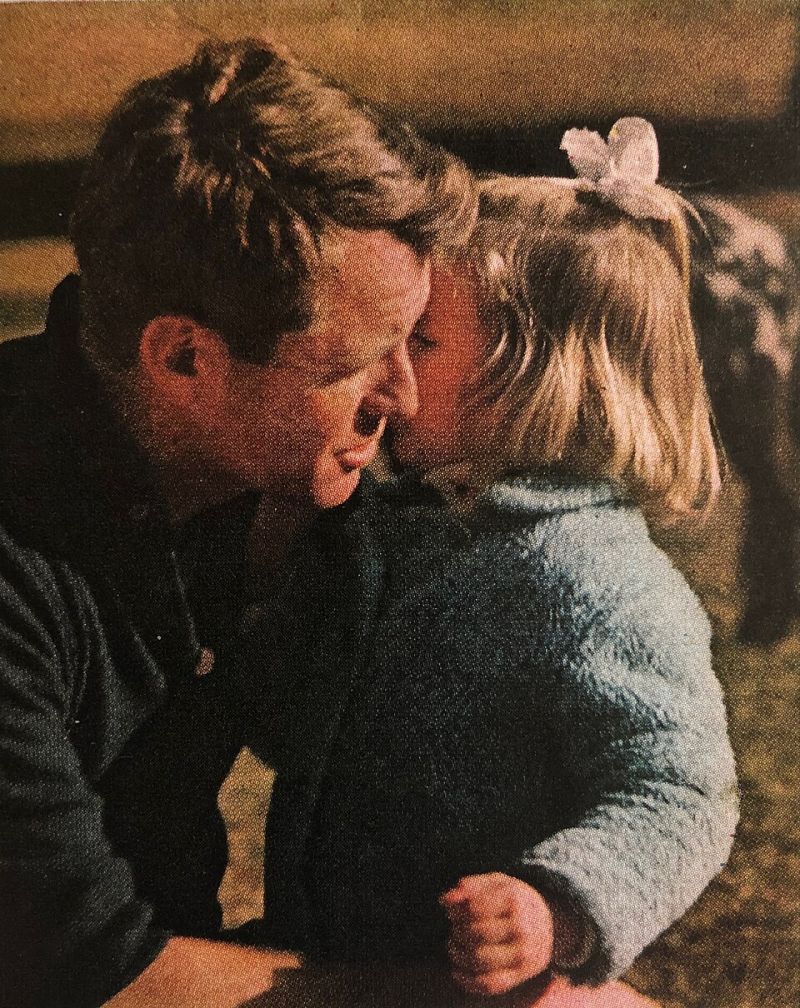
Like her father, her journey began, as so many do, in the classrooms. She graduated from the prestigious Brown University and then deepened her commitment to justice at the no less prestigious Boston College Law School, where she earned her Juris Doctorate. This solid training was not just a title; it was the groundwork on which she would build a lifetime of responsible and strategic activism.
However, her commitment to knowledge was not only born in the classroom, but also from a vital need to understand and give voice to those who struggle. Among her books, she is the author of a seminal work, “Speaking Truth to Power: Human Rights Defenders Who Are Changing Our World.” In it, she not only wrote, listened, and interviewed, but also captured the stories of courage from activists around the planet. This book transcended the pages to become the basis for a global educational program that today teaches human rights in schools and universities, from Spain to America, sowing the seeds of justice, tolerance, and democratic and human values in new generations.
And that intellectual rigor is the same that she has applied when leading the Robert F. Kennedy Human Rights Foundation. Under her leadership, the organization is not only a loud voice of protest but also a center of intelligent and effective action.
Her parallel journey into academia began in 1981, when she undertook an academic internship at Amnesty International, investigating human rights abuses in El Salvador. Since then, she has dedicated her life to pursuing equal justice and protecting the rule of law. Under her leadership as president of the Robert F. Kennedy Human Rights Foundation, the organization has become a vital partner for human rights defenders worldwide, operating in over sixty countries.
Her work is as broad as the rights it seeks to protect. To understand the tangible impact of Kerry’s work, we can look at just some of her most notable campaigns:
- Criminal Justice Reform: Kerry has fought against the injustices of the prison system. Her organization gave bail of $100,000 to release Pedro Hernández, a teenager who had been in preventive detention at Rikers Island for more than a year without a conviction. Shortly after, the charges were dropped. She also tirelessly advocated for “Kalief’s Law,” legislation aimed at ensuring speedy trials and ending prolonged detention without sentencing.
- Immigrant Rights: In response to the 2018 “zero tolerance” policy, Kerry launched the “Break Bread, Not Families” campaign. Along with Dolores Huerta, she led marches and vigils in Texas, even risking arrest to raise her voice against family separation, a practice she denounced as “immoral and illegal.”
- A Global View of Human Rights: Her work has spanned an extraordinary range of causes, from women’s and indigenous peoples’ rights to freedom of expression and environmental justice, demonstrating a holistic understanding that human rights are indivisible.
Kerry Kennedy’s commitment has not gone unnoticed. For this exceptional career, which unites critical thinking with compassionate action, she has been recognized with the Oscar Romero Human Rights Award from the University of Dayton in 2025 and with the Medal for Social Activism from the World Summit of Nobel Peace Prize Laureates. Several universities, including Le Moyne College and the University of San Francisco Law School, have awarded her honorary doctorates, recognizing her not only as a responsible activist but also as a scholar and mentor.
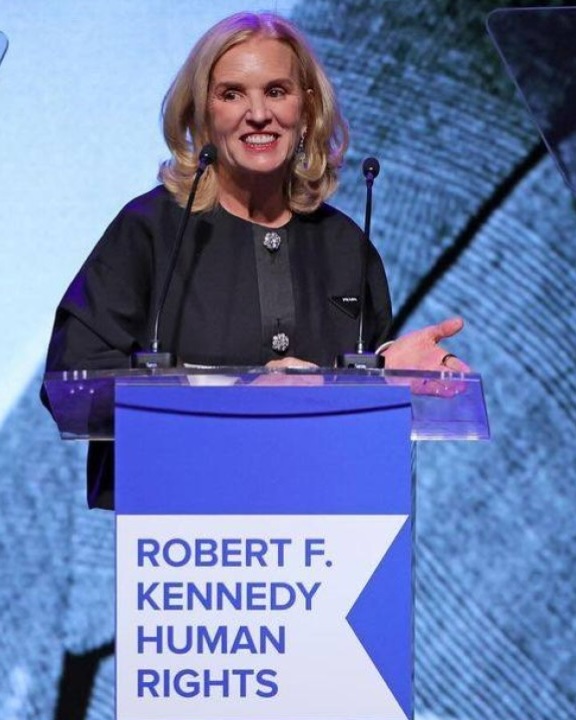
This very brief profile, as a sample, omits hundreds of actions and achievements that have inspired us throughout her career. Kerry Kennedy, above all, shows us that the fight for a more just world is not only fought in the streets, but also in the classrooms, in books, and in the rigorous study of the law. She embodies the idea that the true force for changing the world comes from the union of knowledge and compassion. Kerry precisely reinforced this conviction during the Oscar Romero Award, emphasizing that “the fight for human rights requires courage, compassion, and an unwavering commitment to justice for all.” Those words are not just a declaration of principles; they are the summary of her life.
In a world often overwhelmed by division and despair, as she herself has expressed, her work reminds each of us, with our abilities and our knowledge, with our talent and disposition, of the power of a single person to send “a small ripple of hope.” Those ripples, when crossed, as Robert F. Kennedy said, “build a current which can sweep down the mightiest walls of oppression and resistance.”
Kerry Kennedy inspires us not to remain silent, to use our voices and our platforms, no matter how big or small, to act and improve the lot of others. Thus, we will have fulfilled our conscience and what the human values of education mean, in the force of the word, compassion, and the law. But to achieve these goals, in addition to determination, persistence, and high ethical standards, I have always believed it was necessary to return to our origins. You must relearn to feel to understand.
We live in a world torn apart and diminished in its physical and social environment that seeks to absolve or pardon its guilt through the absurd claim that the morality that has given us human rights, the rejection of cruelty, and compassion for human suffering is a morality of losers. People like Kerry make us see that, while that part of the world exists, there is another world that feels, as Bertrand Russell said, “an unbearable pity for the suffering of mankind.” We are convinced that the greatest gift that people like her can give to those of us who desire a more powerful vision of universal morality is, with crystal clarity, the example of her own life.
@ 2025 Miguel Ángel Escotet. All rights reserved. It can be reproduced by citing the source and the author. These words correspond to my laudatio at the appointment of Kerry Kennedy as Law honoris causa professor of the Intercontinental Business University (UIE), on November 3, 2025, in Santiago de Compostela.
Photo credits: (1) Robert F. Kennedy and Kerry, Look Magazine, 1963; (2) Kerry Kennedy, RFKHR Foundation, 2025.