- July 19, 2021
- Education, Educational Philosophy, Higher Education, Learning, Lifelong Learning, Social Philosophy, University
«In a time of drastic change, it is the learners who inherit the future. The learned usually find themselves equipped to live in a world that no longer exists.»
Recently, during an education conference, I referenced a passage from the beautiful and profound story of Alice in Wonderland. One of the characters of the story, the Red Queen, invites Alice to run incessantly and desperately. In this frantic race, Alice realizes that no matter how fast they run, they actually remain in the same spot. Exhausted after the race, Alice says to the Queen, “In our country, you’d generally get somewhere else if you run very fast for a long time, as we’ve been doing.” The Queen replies, “A slow sort of country! Here, you see, it takes all the running you can do to keep in the same place. If you want to get somewhere else, you must run at least twice as fast as that!” That is the reality of education, of the world of knowledge. You have to be in a permanent race to be in the same place because if you stop running, you start to fall behind. To be able to advance and get somewhere else, one would have, as the Red Queen says, to be constantly running without stopping.
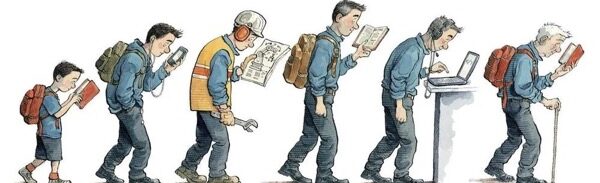
Thus, education is simply an endless process, and learning is a continuous journey with no return. Education, specifically at schools and universities, must revolutionize its current nature to embrace constant change, foster learning to anticipate the future and solve new problems, and provide an ethical and supportive meaning to life. These changes must first take place within the university’s actors themselves. The objective of education must be transformed from being a requirement to merely help us find a job to becoming a professional area where the interests, skills, and satisfaction of the individual prevail. Many educational institutions are only committed to superficial, cosmetic, and simple structural changes, as well as to maintaining fragmented and terminal learning. In that case, they will experience something similar to living in Alice’s Wonderland: they will be left behind, having failed to run fast enough to stay in the same place of integral knowledge, culture, solidarity, and freedom. Eric Hoffer was quite right when he pointed out that, “In a time of drastic change, it is the learners who inherit the future. The learned usually find themselves equipped to live in a world that no longer exists.”
For this reason, university institutions of the future will not measure the acquisition of knowledge according to the time used, neither in careers, nor in degrees, nor in certificates. A demonstration of academic and professional competencies throughout life will gradually replace college degrees. University faculty will also be required to fulfill these competencies. The cognitive, metacognitive, and affective competencies of each student will be self-evaluated and permanently assessed. At the same time, the transversal competencies that define specialties and areas of knowledge in the educational and professional continuum will be developed throughout the curriculum. The breadth and depth of expertise will necessitate the need to relearn and, even more challenging, unlearn, particularly when we work with affective skills and utilize the capacities of emotional intelligence. It is proven that, in most cases, it is more difficult to unlearn old behaviors than to learn new ones.
Exactly forty-five years ago, at the celebration of the First International Congress on New Forms of Postsecondary Education (LACFEP) in Caracas, Venezuela, I pointed out that the new electronic media would be inevitable and necessary in the didactic strategies of learning and that all that these dazzling learning aids could accomplish was to deliver a “trained” person. But what we want and need is an “educated” person: a human being capable of understanding the dizzying world of his time and capable of adapting to it and transforming it. The men and women trained by machines will promptly realize that the skills they were taught quickly become obsolete. In turn, the educated person will develop new skills when necessary and will be able to give ethical significance to their life. These educated people will not compete fiercely with their contemporaries, but with themselves. Let us support this desire from the university by prioritizing education throughout an individual’s lifetime.
___________________________
©2021 Miguel Angel Escotet. All rights reserved. This article is also published in Spanish by La Voz de Galicia at https://www.lavozdegalicia.es/noticia/educacion/2021/07/13/aprendices-vida/0003_202107G13P18991.htm. The appropriate citation in English is as follows: Escotet, Miguel Angel (2021). Lifelong Learners. Scholarly Blog, retrieved from: https://miguelescotet.com/main/2021/lifelong-learners/
Puede leer la versión en español en: https://miguelescotet.com/main/2021/lifelong-learners/